

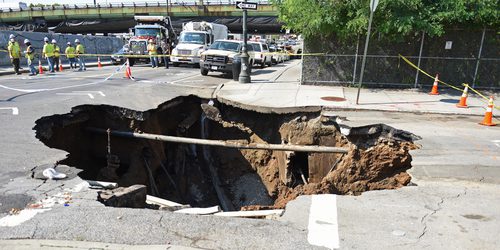
A police department in West Virginia is in great danger as a massive sinkhole beneath it grows larger, threatening to swallow it.
According to the officials, the sinkhole poses a threat to the Hinton police department as it grows larger since first opening up in June.
In an official statement released by West Virginia Department of Transportation (WVDOT) during a press release on Friday, the authorities revealed that the sinkhole was initially about six feet wide and 30 feet deep when it first opened on West Virginia Route 20 in June, following a 90-year-old drain underneath the road started failing which caused it to collapse.
As a result, to temporarily fix the issue, the West Virginia Division of Highways (WVDOH) reportedly installed a temporary culvert that is 120-foot wide and fill material.
However, when the rain from the hurricane Nicole struck the city earlier this month, it washed out the fill and subsequently worsened the condition, making the sinkhole even bigger.
In the press release, the officials claimed that the WVDOH will start the installation of a temporary bridge over the sinkhole on Saturday.
Officials also reminded the public that the traffic in the area would be redirected for a detour during the construction, which will take between 24 and 48 hours.
Meanwhile, students from grade 6 to 13 have switched their learning modes from face-to-face to remote last week due to the expansion of the sinkhole.
In addition, David Warvel, the superintendent of Summers County Schools, made it clear that in-person classes will resume once the temporary bridge has been installed.
In a post released by West Virginia state Sen. Stephen Baldwin on Facebook, he stated that “the bridge is a short-term initiative before the permanent solution will be enforced eventually by installing a 300-foot steel drainage structure. The long-term fixed construction will cost the state around $5 million,” the People reported.
The United States Geological Survey (USGS) said that its data showed that sinkholes “are most common in regions where the types of rock below the land surface can naturally be dissolved by groundwater circulating through them,” the report added.
The USGS also claimed that soluble rocks include salt beds and domes, gypsum, limestone, and other carbonate rock.